The narrator’s attempt to banish the Raven
The RavenThe narrator’s attempt to banish the Raven is the poem’s most explicit effort to recover authority over the chamber, the memory of Lenore, and the speaker’s own emotional life. By ordering the bird to depart, the narrator tries to convert unbearable grief into an act of command; the Raven’s unchanged answer, “Nevermore,” makes that command ineffective and leaves the speaker enclosed within the very loneliness he sought to break.
Causes and Background
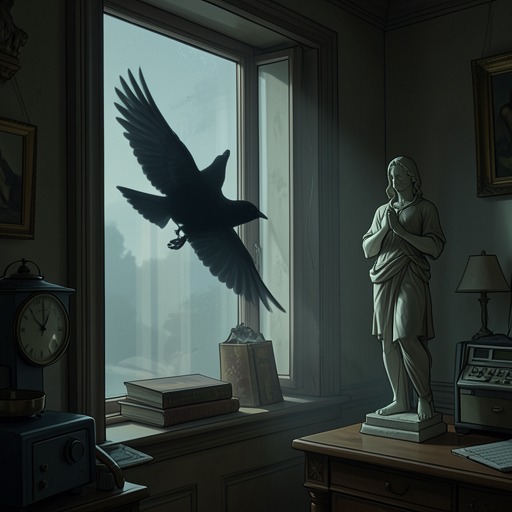
The attempt follows a sequence of increasingly unsuccessful efforts to regulate sorrow. The narrator had wished for the morrow and had sought relief from his books, but reading could not relieve his sorrow for the lost Lenore. The uncertain rustling of the purple curtains intensified his fear, so he first managed the beating of his heart by repeating an ordinary explanation for the disturbance: a visitor was seeking entrance at the chamber door. After opening the door and finding nothing, he regained enough composure to investigate the window; that action brought the Raven into the room.
The bird’s arrival gives the narrator a temporary diversion. The stately Raven enters without obeisance and perches above the chamber door on a bust of Pallas. Its grave decorum beguiles the narrator’s sad fancy into smiling, and the narrator tries to domesticate the encounter by treating the bird as an eccentric visitor whose name might be learned. The Raven’s first “Nevermore” seems to have little meaning or relevancy, but the narrator’s repeated questioning gradually transforms the word into an ominous instrument. The bird is no longer merely an animal at the threshold of the room; it has become the fixed voice against which every attempt at interpretation and emotional control fails.
The Expulsion Command
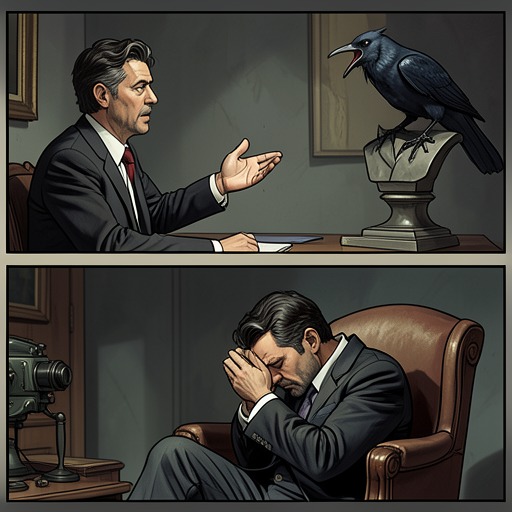
The narrator’s command begins as a sign of parting and quickly becomes an extended act of expulsion. He shrieks, upstarting, “Be that our sign of parting, bird or fiend!” The phrasing reveals the conflict at the center of the action: the Raven is still described as possibly a bird, yet it is also addressed as a fiend. The narrator cannot establish whether he confronts an animal, a supernatural messenger, or a projection of his own despair, but he can still attempt to impose a boundary through speech.
He orders the Raven to return “into the tempest and the Night's Plutonian shore,” sending it back toward the dark region from which he imagines it may have come. The geography of the command is deliberately remote and infernal. The narrator does not simply ask the bird to leave the room; he tries to remove it from the entire imaginative world of the poem, directing it away from the chamber and toward the Night’s Plutonian shore.
The command then becomes an appeal to erase evidence. The narrator orders the Raven to leave no black plume as a token of the lie its soul has spoken. The black plume would make the bird’s presence material and enduring, while the word “token” connects its body with the painful meaning attached to its answers. Expulsion therefore requires more than physical departure: the narrator wants the Raven to take its signs, its speech, and its authority with it.
Loneliness and the Failure of Speech
The most intimate part of the command is the plea, “Leave my loneliness unbroken!—quit the bust above my door!” The narrator presents solitude as something that can be invaded, interrupted, and perhaps restored. Yet the line also exposes the contradiction in his demand. The Raven has made his loneliness visible, but the narrator’s loneliness predates the bird, arising from the loss of Lenore and the failure of books to provide surcease from sorrow. The visitor does not create the grief; it gives grief a body, a perch, and a repeated voice.
The narrator’s final injunction shifts from the Raven’s surroundings to the narrator’s own body: “Take thy beak from out my heart, and take thy form from off my door!” The bird’s beak is imagined as penetrating the heart, while its form occupies the doorway above him. The command thus joins inward pain to outward presence. The narrator seeks release both from the wound represented by the beak and from the visible shape that sustains it. The attempt to banish the Raven is consequently an effort to sever the link between physical object, remembered loss, and continuing anguish.
The speech is a performative act in intention: the narrator speaks as though naming departure could make departure occur. Earlier, he had repeated explanations to calm himself, addressed the bird to give it an identity, and invoked a possible supernatural meaning for its arrival. Here, speech reaches its strongest imperative form. Its failure is therefore especially severe. The Raven does not debate the order or acknowledge the narrator’s authority; it answers only, “Nevermore.” The same word that once seemed irrelevant now functions as an absolute refusal.
The Raven’s Refusal and the Final Image
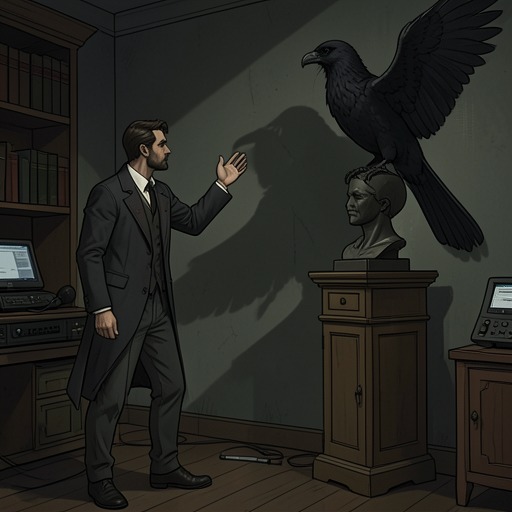
The Raven’s answer is followed by no movement away from the chamber. Instead, the Raven is described as never flitting, still sitting, still sitting on the pallid bust of Pallas above the chamber door. The repetition of its posture mirrors the repetition of its word. The narrator’s command has produced no change in the bird’s position, and the bird’s immobility makes the attempted expulsion look less like a failed request than a defeated struggle over possession of the room.
The bust of Pallas gives the refusal an intellectual and symbolic setting, while the Raven remains an animal presence that cannot be absorbed into the narrator’s rational explanations. Earlier, the narrator had marvelled that the ungainly fowl could hear discourse so plainly; later, he had called it a prophet and a thing of evil, whether sent by a Tempter or tossed ashore by a tempest. These changing names show the narrator repeatedly assigning the Raven new kinds of agency. The bird is alternately treated as bird, ancient Raven, prophet, and fiend, but none of those classifications enables the narrator to control it.
The final visual consequence is equally important. The lamp-light streams over the Raven and throws its shadows onto the floor, while the bird’s eyes have the seeming of a demon that is dreaming. The shadow outlasts the command and becomes the image from which the narrator’s soul cannot escape. The narrator’s attempt to remove the Raven therefore ends by confirming its permanence: the visitor remains above the door, its shadow remains on the floor, and the speaker’s soul remains bound to that shadow.
Narrative Significance
As an action, the expulsion command reverses the expected movement of a visitor scene. A frightened inhabitant investigates a disturbance, admits or encounters a stranger, and then attempts to restore the room’s former order. Here, each act of investigation deepens the disorder, and the final command cannot re-establish the boundary between inside and outside. The Raven’s refusal converts the chamber into a closed emotional and symbolic space.
The action also gathers the narrator’s failed strategies into one last confrontation. Reading did not provide relief; repetition offered only temporary reassurance; explanation could not account for the Raven; naming the bird did not make it intelligible; and appeals to divine respite and nepenthe did not erase the memory of Lenore. The attempt to banish the Raven is the most forceful of these strategies because it abandons interpretation for command. Its failure demonstrates that the narrator’s grief cannot be dismissed by willpower or language, and that the Raven’s “Nevermore” has become inseparable from the narrator’s continuing loneliness.